Lightweight, for any platform
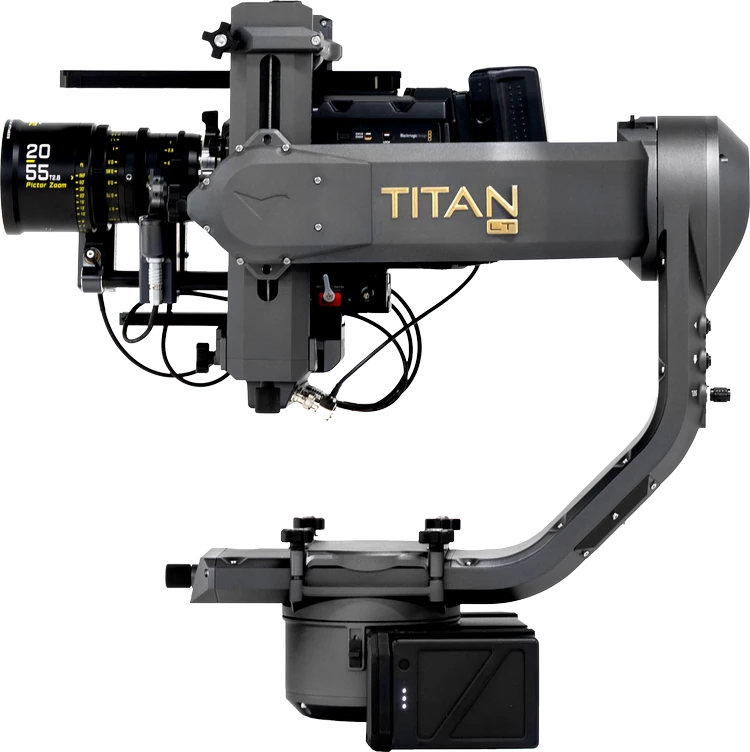
At 8.2 kg the TITAN LT suits every kind of remote head support: MotoCrane arms, the Flowcine Black Arm, cable cams such as the Dactylcam Pro 48v, telescopic cranes like our MovieBird techno cranes, dollies and jibs, RC cars — and even handheld.
Big motors for big payloads
A new motor design gives 3.5 times the peak torque of the Ronin 2, for fast response and whip pans. Pan torque reaches 10 Nm, pan speed 360° per second, and the head is rated for vehicle speeds of 130+ mph (over 200 km/h).
Next-level stabilization
The head runs the third generation of TITAN Sensor Fusion with GPS, for precise stabilization in turbulent conditions. DYNAMIC mode keeps the image steady off-road and on long telephoto lenses.
Quiet on set
For sync-sound recording and other noise-sensitive environments, STUDIO mode tunes the head for smooth and quiet operation.
Rain or shine
The internals are sealed to IP65, so rain and dust on difficult locations are not a worry for the head. The camera itself still needs its rain cover.
Fully integrated
SDI video, focus, iris and zoom control, 12V and 24V power are all built into the head for the camera and its accessories. It works with MotoCrane lens motors and a growing list of third-party motors such as Preston, Heden and ARRI; the Servo Lens Controller (SLC) adds native control of Canon and Fujinon servo zoom lenses.
360° infinite pan & roll
Slip rings on both the pan and the roll axis allow unrestricted rotation, even for complex moves through the roll axis. All power, signal and SDI video run inside the structure, so there are no external cables to snag.
The TITAN controller
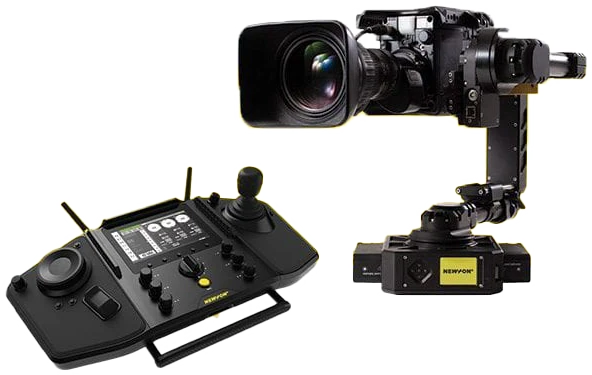
The controller is machined from 6061 aluminium and has an intuitive touchscreen interface. Joysticks and the focus wheel can sit on the left or the right, two single-axis joysticks can give discrete pan and tilt control, and the link can be wireless or hardwired for busy RF environments. Wheels operators can use TITAN Wheels or NODO Inertia Wheels.
Easy for Ronin 2 crews
The TITAN LT takes the same baseplate as the DJI Ronin 2, and payload mounting, balancing, axis locks and balance adjustment work the same way — so there is no learning curve. With the modular power expansions it can even run on TB50 batteries.